GitHub Actions Reusable Workflows: Standardize Delivery Without Blocking Teams

Content authorBy Irina BaghdyanPublished onReading time12 min read
Automated manufacturing production line with industrial machinery, conveyor systems, and digital monitoring equipment

Copy-pasted pipelines drift. Across a large GitHub organization, every duplicated workflow becomes a separate place to patch, audit, and get wrong. Replace them with a centrally maintained set of GitHub Actions reusable workflows, structured so teams can adopt them without friction. Pair that structure with a governance model that keeps shadow pipelines from creeping back in.

The real cost of forty copies of the same pipeline

Most organizations arrive at GitHub Actions reusable workflows the same way: the fortieth repository copies the deploy pipeline, and the forty-first copies it wrong. Nobody budgets for that. The cost shows up as a security patch that lands in eleven repositories out of sixty and an audit question no one can answer in a single query.

The instinct is to centralize everything and mandate it. That instinct produces a different failure, where application teams route around the platform because the platform refuses to let them deploy a service that doesn't fit the template. CI/CD workflow standardization works when the central layer owns the controls that must never vary and leaves the rest alone. The rest of this guide is about drawing that line and then making it hold under version pressure and security review.

Set the standardization boundary

Start by sorting your pipeline logic into two buckets. One holds controls where variation is a liability: artifact signing and how a production deployment gets approved. The other holds decisions that belong to whoever owns the service, like test matrix size and build tooling.

That split is the whole design. If a control belongs in the first bucket and you implement it as advice, it will be ignored in the repositories you care about most. If a decision belongs in the second bucket and you centralize it, you've made your platform team the bottleneck for every framework upgrade in the company. Charity Majors, CTO of Honeycomb, described the supported-path model bluntly: "Pave the path with gold. Nobody HAS to use these components … but if they don't, they're on their own."

GitHub gives you three mechanisms here, and they are not interchangeable:

  • GitHub Actions reusable workflows are called with uses at the job level from a caller workflow. They can contain multiple jobs and accept secrets, which is why they carry mandatory controls. You can connect up to ten levels of workflows and call a maximum of 50 unique ones from a single top-level file.

  • Composite actions bundle steps inside a job. They cannot use secrets and log as a single step, which makes them right for shared step sequences and wrong for release gates.

  • GitHub Actions workflow templates live in the workflow-templates directory of your organization's .github repository and get copied into a repository once.

The copy is the problem. GitHub Actions workflow templates are good for scaffolding a new service, because a developer picks one and edits it freely. But the moment it's copied, it stops receiving your fixes, so GitHub Actions workflow templates should scaffold the caller workflow and nothing more.

Structure GitHub Actions reusable workflows

Put the shared layer in one internal repository and treat it as a product with consumers. Splitting it across five repositories feels tidy and then costs you a coordinated release every time a build change touches a deployment change. One repository, one place to look when a pipeline breaks at 2 a.m.

Inside .github/workflows, separate the callable surface by purpose rather than by team. A practical layout keeps ci-*.yml for build and test and deploy-*.yml for environment promotion, with supporting composite actions in a sibling actions/ directory. Everything else in the repository exists to make changes safe: a tests/ tree and documentation that names the stable inputs.

That last part is what separates a shared repository from a dumping ground. When workflow templates became available for organizations, GitHub's own framing of GitHub Actions workflow templates was config as code with full auditability, and the same expectation applies here. If a consuming team can't read your docs and predict what a version bump will do, your CI/CD workflow standardization effort is a guessing game with higher stakes. The broader cloud DevOps operating model can reinforce those boundaries.

Design workflow contracts

A callable workflow is an interface, so write it like one. The workflow_call trigger gives you typed inputs with defaults and declared outputs, and those are your entire contract. Keep the input list short and strongly typed, because every optional string you add is a branch you now have to test forever.

Two boundary behaviors trip teams up in their first week with GitHub Actions reusable workflows. Environment variables set in the caller don't cross into the called workflow, and values produced inside it don't flow back unless you declare them, so outputs must map from job outputs to workflow outputs deliberately. Deployment metadata like image digests and release tags belongs in declared outputs.

Controlled customization lives in the inputs. Give teams a test-command input or an optional extra-scan-paths array if that's genuinely their decision, and refuse the input that lets a caller skip signing. An interface that can be told to do nothing is not a control.

Need IT Support?

Book a free consultation with ABS Technologies experts we'll help you find the right managed IT, cloud, or security solution for your business.

Book a Free Consultation →

Apply least privilege

Set permissions explicitly at the top of every called workflow and grant write scopes per job. GitHub enforces a useful direction of travel here: in a nested chain, GITHUB_TOKEN permissions can only be the same or more restrictive further down, never elevated. Design your top-level callers with that in mind, because a permissive entry point undoes careful scoping three levels deeper.

For cloud access, stop shipping long-lived keys. OpenID Connect (OIDC) lets a job exchange a signed token for a short-lived access token that expires after the job, which removes the credential that gets stolen in the first place. Pair that with GitHub environments so production deployments inherit required reviewers and branch restrictions from the environment rather than from a convention in YAML.

The supply chain side deserves equal attention. GitHub recommends pinning actions to a full-length commit SHA because a tag is a movable pointer, and since August 2025 administrators can enforce SHA pinning through the allowed actions policy. The reason is not theoretical. The compromise of tj-actions/changed-files hit over 23,000 repositories after an attacker repointed tags v1 through v45.0.7 at a malicious commit, and CISA added CVE-2025-30066 to its Known Exploited Vulnerabilities Catalog within two weeks.

One more rule, and it's unpopular: secrets: inherit should be the exception you can name and justify. Map secrets individually so a reader of the caller workflow can see exactly what the called workflow is allowed to touch.

CI/CD workflow standardization

Sort every control into one of three tiers and publish the sorting, because ambiguity is what drives teams to build their own pipeline in a branch nobody reviews.

  1. Mandatory and non-configurable. Artifact signing and the production approval gate. These run with no input that can disable them, and the platform team owns their behavior.

  2. Paved-road defaults. Build caching strategy and deployment strategy per environment. Sensible out of the box, overridable through declared inputs.

  3. Optional extensions. Performance benchmarks and custom notification jobs. These live in the consuming repository as additional jobs in the caller workflow.

Tier three is what keeps adoption voluntary in spirit while the first tier stays mandatory in fact. A caller workflow can add any number of its own jobs alongside the call to your workflow, so a team with an unusual requirement adds a job instead of forking your pipeline. To make the first tier of GitHub Actions reusable workflows enforceable rather than aspirational, GitHub Enterprise Cloud lets you require workflows to pass before a pull request merges, targeted by repository and branch through organization rulesets. For a broader view of CI/CD automation, see how repeatable delivery systems support governance and scale.

This tiering is also the clearest artifact your CI/CD workflow standardization program produces. Auditors read it, and you reference it every time someone asks for an exception.

Need IT Support?

Book a free consultation with ABS Technologies experts we'll help you find the right managed IT, cloud, or security solution for your business.

Book a Free Consultation →

Build a release model
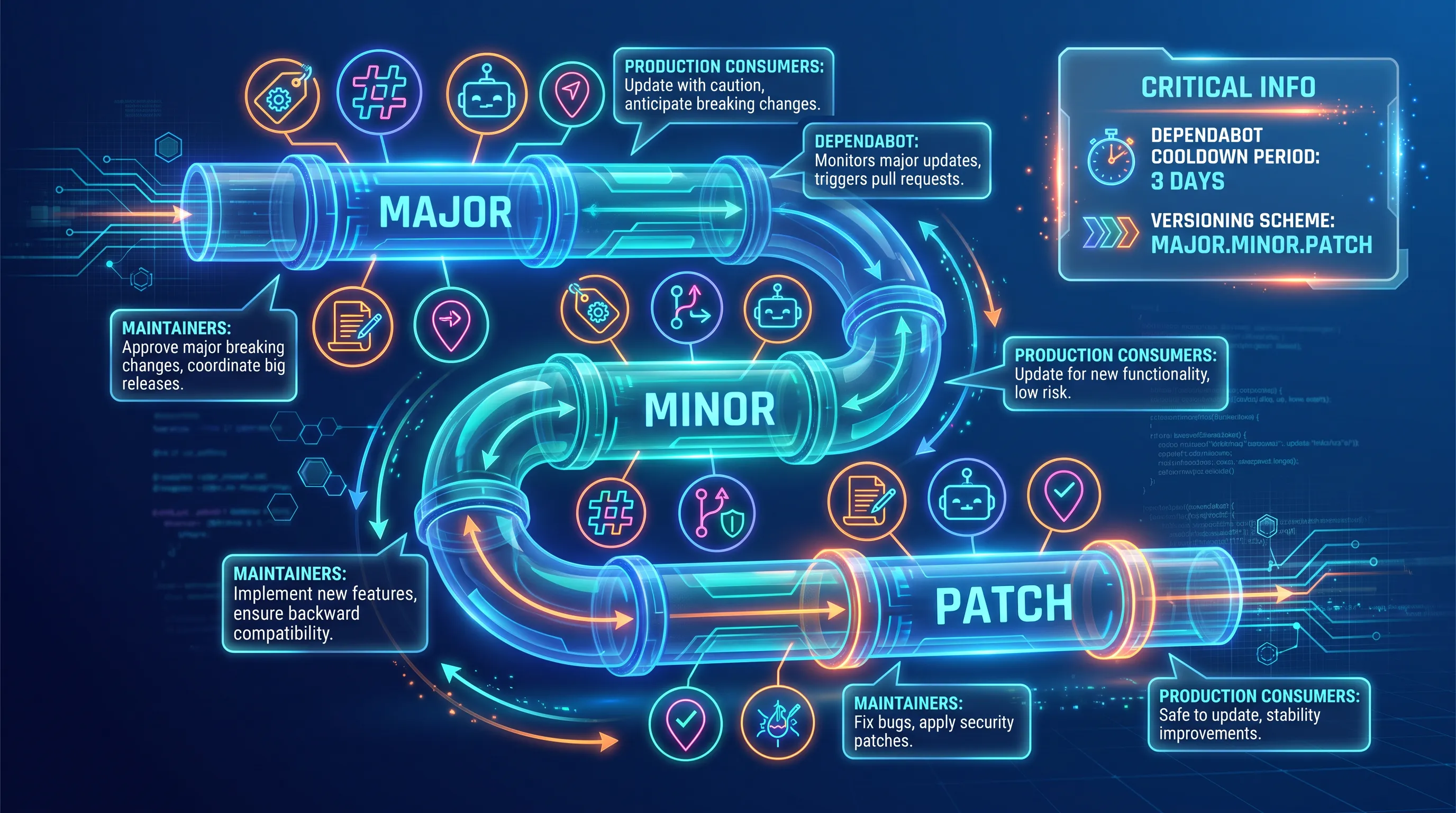
A vibrant neon infographic illustrating versioning and release management, featuring a glowing segmented pipeline and colorful icons.

Version the shared repository with MAJOR.MINOR.PATCH semantics and mean it. A minor release adds an optional input or a new output. A patch fixes behavior without touching the contract. A major release changes or removes an input, or tightens a mandatory control in a way that will fail existing builds.

Production consumers should never reference a moving branch. If callers point at @main, every merge in your platform repository is an unannounced change to every production deployment in the company, and your rollback story becomes a revert race. Pin consumers to a release tag for ordinary teams and to a full commit SHA for regulated services, then let Dependabot track those references and open the upgrade as a reviewable pull request. Dependabot applies a 3-day cooldown to version updates by default, which gives a fresh release time to settle before it lands in sixty repositories.

Write down the compatibility promise alongside the version scheme. Mine looks like this: minor and patch releases never break a working caller, and major releases ship with a migration note and a dated deprecation window. Publish a changelog entry for every release that names the affected inputs, because "updated deploy workflow" tells a consuming team nothing they can act on.

Test before release

Shared GitHub Actions reusable workflows fail differently from application code. A mistake breaks the ability to ship anything, which is why the shared repository needs a stricter test gate than the services consuming it. Build it in layers so feedback stays fast.

Static checks come first. actionlint parses workflow YAML and type-checks expressions, so most contract mistakes die in under a second. Add policy validation on top: every action pinned to a SHA and every workflow declaring explicit permissions.

Then test behavior against real repositories. Keep two or three sandbox repositories in the organization that represent your actual stack and have them call the release candidate on a schedule that includes a full deployment to a disposable environment. The scenarios that matter are the ones nobody writes by default:

  • A failing build that must fail the caller, and a flaky step that must not silently pass.

  • A job run with insufficient permissions, to confirm it fails loudly rather than skipping the control.

  • A missing or empty required secret, and a caller that reads declared outputs.

  • A caller written against the previous major version, to catch unintended breaking changes.

Promote by tag. A green release candidate gets the release tag, and the release tag is what consumers move to. If a problem surfaces after promotion, consumers roll back by pointing at the previous tag, which takes one pull request per repository and no coordination with your team.

Migrate repositories safely

Inventory before you touch anything. Pull every workflow file in the organization through the API to prepare GitHub Actions reusable workflows, then classify by what the pipeline actually does and which environments it deploys to. The output you want is a short list of pipeline archetypes rather than a list of repositories, because that list tells you how many GitHub Actions reusable workflows you need.

Then sequence the rollout rather than announcing a deadline. GitHub Actions reusable workflows migrate well in cohorts, and badly in big bangs.

  1. Pick two pilot repositories per archetype, one low-risk and one that genuinely matters, with a team willing to give you honest feedback.

  2. Add a thin caller workflow that runs in parallel with the existing pipeline. Nothing is removed yet.

  3. Compare results for a sprint. Build outputs and deployment behavior. Differences here are either bugs in your workflow or undocumented behavior in theirs, and both are worth finding before cohort two.

  4. Retire the old pipeline in the pilots, then expand by cohort with GitHub Actions workflow templates to scaffold the caller workflow for each new repository.

  5. Delete the duplicated files. Migration that leaves both pipelines in place has produced more maintenance.

Keep the rollback path trivial at every step: the old workflow file stays in Git history, and restoring it is one revert. Track adoption with numbers you can defend, like the share of production deployments running through the shared layer and the count of repositories still carrying a hand-maintained deploy pipeline. The 2024 DORA research is a useful caution here, because an internal platform improves individual productivity while it can reduce change stability during the transition, which is exactly why cohorts and comparison runs are not optional. Teams can also use platform engineering practices to make the migration easier to operate at scale.

Govern reusable workflows

Name one owning team and make the ownership visible. A CODEOWNERS entry on .github/workflows means review is automatically requested from that team on every change, and a security reviewer should be a required approver on anything touching permissions or signing. Pair that with service-level expectations your consumers can plan around, which cover response time on a broken release and support window per major version.

Exceptions are where governance programs either hold or collapse. Grant them in writing and attach an expiry date. A permanent exception is a second standard you're now maintaining in silence. For visibility into who depends on GitHub Actions reusable workflows, the API reports which workflow files were involved in a run, which turns "who is still on v2" into a query rather than a survey.

Communication closes the loop. Announce breaking changes with the migration note before the release and let Dependabot deliver routine upgrades as pull requests. Dianne Marsh, then Director of Engineering at Netflix, described the supported path as "expectations and commitments" between the central team and its engineering customers, and that framing is the right one. CI/CD workflow standardization is a product relationship with versions and support.

Plan the next step

Before rollout, document the control tiers and the version and compatibility promise, along with the exception process with expiry rules and the migration cohorts with their rollback paths. Those four documents will answer most of the questions your first six months generate.

ABS Technologies builds and automates CI/CD pipelines as part of our cloud and DevOps practice, which includes the platform-level design work this guide describes. If you're weighing an architecture review or a migration-readiness assessment for GitHub Actions reusable workflows, reach out to our team.


Need IT Support?

Book a free consultation with ABS Technologies experts we'll help you find the right managed IT, cloud, or security solution for your business.

Book a Free Consultation →

A caller using the older contract can fail validation before its jobs start. Treat a newly required input as a breaking change, release it under a new major version, document the replacement value, and update callers through reviewed pull requests before moving the shared reference.

Keep validation and deployment in separate jobs, and allow deployment credentials only in a protected GitHub environment. Restrict deployment to approved branches or events, use read-only permissions for validation, and require reviewers before production access. A workflow should never expose deployment secrets to code from an untrusted pull request.

Yes. Jobs inside a called workflow run in parallel unless their needs relationships create a dependency, and caller jobs can run alongside the reusable workflow unless they depend on its completion. Define dependencies explicitly when a test, approval, or generated output must exist before the next job starts.

Use workflow outputs for small values that later jobs need, such as an image digest or release identifier. Use artifacts for files that must be downloaded or inspected, such as test reports or packages. Declare each output at the workflow level and map it from the producing job.

Contact ABS Technologies when your organization needs an architecture review or a migration-readiness assessment for GitHub Actions reusable workflows. Prepare an inventory of workflow files, deployment environments, pipeline archetypes, and current exceptions. That information lets the review focus on control boundaries, rollout order, and rollback planning.

Schedule a Meeting

Book a time that works best for you and let's discuss your project needs.

You Might Also Like

Discover more insights and articles

Modern smart factory with automated industrial machinery, production equipment, and digital manufacturing systems

Replica count changes with load

Routine Kubernetes maintenance should not put business-critical services at risk. Yet poorly configured Pod Disruption Budgets (PDBs) can delay upgrades, block infrastructure maintenance, and increase the risk of service interruptions. For organizations running production workloads, managing PDBs is not simply a Kubernetes configuration task. It is part of maintaining service availability, operational resilience, and predictable infrastructure operations. This guide explains how to configure, validate, and monitor PDBs to support reliable Kubernetes maintenance.

Industrial automation control system with connected electrical components and data infrastructure

Software Supply Chain Security: Controls That Protect Code from Commit to Production

Every step between a developer's commit and a running production workload is a place an attacker can intervene: a poisoned dependency, a tampered build, a stolen pipeline credential, an unsigned image. Mapping these attack paths end to end shows which control interrupts each one and where a single control covers several paths at once. Because funding every control at once is rarely possible, a ranking method then orders the work by the risk each control removes, so limited budgets go first to the gaps attackers are most likely to use.

Business team viewing a digital technology network and interconnected data systems in a modern corporate environment

GitHub Actions Self-Hosted Runners: Secure Architecture and Autoscaling Patterns

Self-hosted GitHub Actions runners give teams control over cost and environment, but they also put build infrastructure inside the trust boundary, where a single compromised workflow can reach internal systems. A defensible architecture starts by naming the threats runners introduce, then applies controls that contain them: ephemeral runners, default-deny network isolation, and short-lived workload identity in place of stored cloud credentials. Scaling models sized to real demand keep capacity honest rather than padded. A cost model and a migration path off persistent runners complete the case, laid out so engineering and finance can review and approve it in a single meeting.

Futuristic digital system with connected components and data flows representing document workflow automation

HashiCorp Vault Secrets Management: Architecture, Adoption, and Operational Reality

The real shift in secrets management comes from long-lived, standing credentials to workload identity that issues short-lived ones on demand. HashiCorp Vault secrets management is one route to that shift, but it fits only some environments. This guide lays out the difference: where Vault earns its operational cost, when a simpler managed store is the better call, and how to sequence adoption without a disruptive cutover.